Iran Shoots Down US MQ-1 Drone Near Strait of Hormuz, 14th Downed in War, IRGC Says
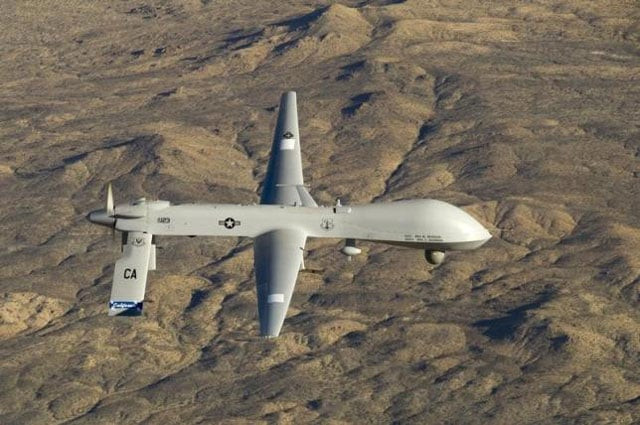
Photo: Reuters via Express Tribune, file photo (a US MQ-1 Predator in 2012, not the drone downed near Hormuz)
Iran says it shot down a US MQ-1 drone near the Strait of Hormuz on Thursday, the 14th MQ-1 it claims to have brought down in the war, as mediators led by Qatar press a deal that would let UN inspectors into Iran's bombed nuclear sites in return for some relief from sanctions.
Iran's Islamic Revolutionary Guard Corps (IRGC) said its Aerospace Force intercepted and destroyed the drone east of the Strait of Hormuz, off the coastal city of Sirik, using an advanced air defence system working under Iran's integrated air defence network. Iran's state news agency IRNA and Press TV carried the statement on Thursday morning. There was no immediate comment from Washington, and the claim has not been independently verified.
Main News Report: Iran Shoots Down US MQ-1 Drone Near Hormuz
The IRGC statement said the drone was brought down in the airspace east of the Strait of Hormuz, opposite Sirik on Iran's southern coast. It called the aircraft an advanced MQ-1 drone belonging to the US military, and said it was the 14th such drone its forces have intercepted and destroyed.
The IRGC also gave a running tally of US drones it says it has downed during the war: 54 MQ-9 Reaper drones and 14 MQ-1 drones, 68 in total, according to Al Mayadeen, which reported the statement. That tally is Iran's own count and has not been confirmed by the US.
This is not the first such claim in recent weeks. Earlier this month the IRGC said it shot down an American MQ-9 Reaper over the Strait of Hormuz, and last month the Iranian Army said its air defences downed a US MQ-1 over the same strait, Press TV reported. The pattern shows how much of the current standoff is fought with unmanned aircraft watching each other across the strait.
One detail in the claim is worth noting. The US Air Force retired the MQ-1 Predator in 2018 and replaced it with the larger MQ-9 Reaper. Press TV itself notes the puzzle: after US Central Command reported an American MQ-1 destroyed by Iranian air defences on 31 May, questions arose over whether the aircraft was a reactivated Predator or the Army's MQ-1C Gray Eagle, a similar drone still in service. In plain words, the MQ-1 is an older American surveillance drone, and Iran's claim does not settle which exact model was flying.
Background Context
The Strait of Hormuz is the narrow waterway between Iran and Oman through which a large share of the world's oil moves by tanker. Iran has said it now controls the strait and sets rules for traffic through it, after what IRNA calls the US-Israeli war against Iran that began on 28 February. That is why every drone incident there matters far beyond the strait itself: a clash in these waters can move oil prices within hours, and Pakistan imports much of its fuel through nearby routes.
The drone claim lands in the middle of a tense pause. The United States has warned Gulf states to prepare for a possible short, intense campaign against Iran after the 3 November midterm elections, as reported in our earlier post on the US warning to Gulf states. At the same time, mediators are working to stop the war restarting at all.
Iran only days ago dismissed the latest Qatari mediation ideas as unacceptable, saying they were ideas and not a formal offer, as covered in our post on Iran rejecting the Qatar peace deal ideas. The drone downing now adds a fresh show of force to that same negotiation.
Reactions and Statements
Iranian Foreign Minister Abbas Araghchi said on Wednesday that Iran was in close and ongoing contact with intermediaries to review ideas that could put Tehran's seven-day plan into action. "While our brave armed forces are fully prepared to defend the homeland, Iran continues to give diplomacy a chance to succeed," he wrote on X, adding that the plan to reopen the Strait of Hormuz could be put into effect in even less than a week, Express Tribune reported.
US President Donald Trump told Axios that talks with Iran are taking place through mediators but that he did not know whether they would succeed. "We need to finish the job, either through a deal or another way. We will find out if negotiations can succeed," he said. The Axios report, cited by the Tribune, says mediators led by Qatar are urging Iran to allow UN inspectors to visit the nuclear sites hit by US and Israeli strikes in return for some sanctions relief, with Pakistan, Saudi Arabia, Egypt and Turkiye backing the effort.
The Wall Street Journal has also reported that Vice President JD Vance wrote to Iran's security chief Mohsen Rezaei in an effort to revive talks. Trump has denied directing Vance to open negotiations, saying the contact was about medical supplies and help for people who are not well.
No statement from the US military about the MQ-1 claim had appeared in the reports by late morning Pakistan time. Until Washington responds, the downing stands as an Iranian claim, not a confirmed loss.
Why This News Matters
The key figures in one place:
- 14 MQ-1 drones: the number Iran says it has now downed in the war, counting this one.
- 54 MQ-9 drones: the number Iran claims in the same tally, for a total of 68 US drones.
- Off Sirik: where the IRGC says this drone was brought down, east of the Strait of Hormuz.
- 7 days: the length of Iran's plan to reopen the strait, which Araghchi says could be done in even less time if its conditions are met.
For readers in Pakistan, the link is direct. Pakistan backed the Qatar-led mediation effort, and any deal that eases the Hormuz standoff would help steady fuel supplies and prices at home. The reverse is also true: if the drone incidents keep escalating and the US does strike again after the midterms, Pakistan would feel it through oil prices and regional tension first. That is why a single drone claim, even an unverified one, is worth watching closely.
The inspections-for-sanctions idea is the clearest path out that mediators have put on the table so far. UN inspectors going back into bombed nuclear sites in return for some sanctions relief would give both sides something to show for talking, which is exactly what has been missing since the Qatar deal ideas were dismissed as unacceptable.
Future Developments
Watch for four things next. First, whether the US military confirms or denies losing an MQ-1 near Hormuz. Second, whether Araghchi's seven-day Hormuz plan moves from words to action, and what conditions Tehran attaches to it. Third, whether the Qatar-led mediators turn their inspections-for-sanctions idea into a formal offer, after Iran said the last set of ideas was not one. Fourth, whether more drone incidents follow in the strait, which would signal the quiet standoff is heating up again before the 3 November midterms.
The original Qatari proposal and Tehran's response are set out in our post on the Qatar peace deal given to Iran. If the mediators' new idea gains traction, it will be the first real movement in that negotiation since Iran's rejection.
Sources
- IRNA: IRGC downs MQ-1 drone near Strait of Hormuz
- Express Tribune: Iran intercepts US MQ-1 drone east of Strait of Hormuz
- Press TV: IRGC air defenses down 14th US MQ-1 drone over Strait of Hormuz
- Al Mayadeen: IRGC announces downing of US MQ-1 drone east of Hormuz
- Dawn live blog: War returns to Iran with Israel, US strikes (10:46am entry on the MQ-1 claim)
#Iran #MQ1Drone #Hormuz #MiddleEast #BreakingNews #WorldNews #PakistanNews #USIran


Comments
Post a Comment